"Realize deeply that the present moment is all you have. Make the NOW the primary focus of your life." — Eckhart Tolle
Social media is a normal part of my everyday life. I use platforms like TikTok and Instagram for entertainment, fitness, content creation, and sometimes information. One thing I have noticed is that once I interact with a certain topic, I usually start seeing more of the same content. It can sometimes feel like my entire feed is centered around one idea or viewpoint. This made me interested in the claim that social media algorithms intentionally show people content that confirms what they already believe. Instead of relying only on my own experience, I decided to use the SIFT method and lateral reading to investigate this claim further.
Step 1: Stop and Look at the Claim
I started with an article from The Cybersmile Foundation titled “How Social Media Algorithms Rewire Your Brain.” When I first read the article, I found the overall statement believable because the more we scroll through social media, the more our brains are repeatedly exposed to the information we are consuming. From my own experience, if I interact with one topic, it does not take long before similar videos and posts begin appearing throughout my feed.
I thought this claim was worth evaluating because social media algorithms affect what millions of people see every day, including the information they may use to form opinions and beliefs. One red flag that immediately stood out to me was the phrase “rewire your brain.” That is a strong statement, and it made me skeptical about whether the evidence actually supported such a direct claim. I also questioned whether algorithms truly intend to confirm our beliefs or whether they are mainly responding to our previous activity to keep us engaged. Since the claim sounded believable based on my own social media experience, I knew that my own confirmation bias could influence my judgment. This is why I decided to use the SIFT method and lateral reading to look beyond the original article and compare its claims with outside research before deciding whether it was accurate.
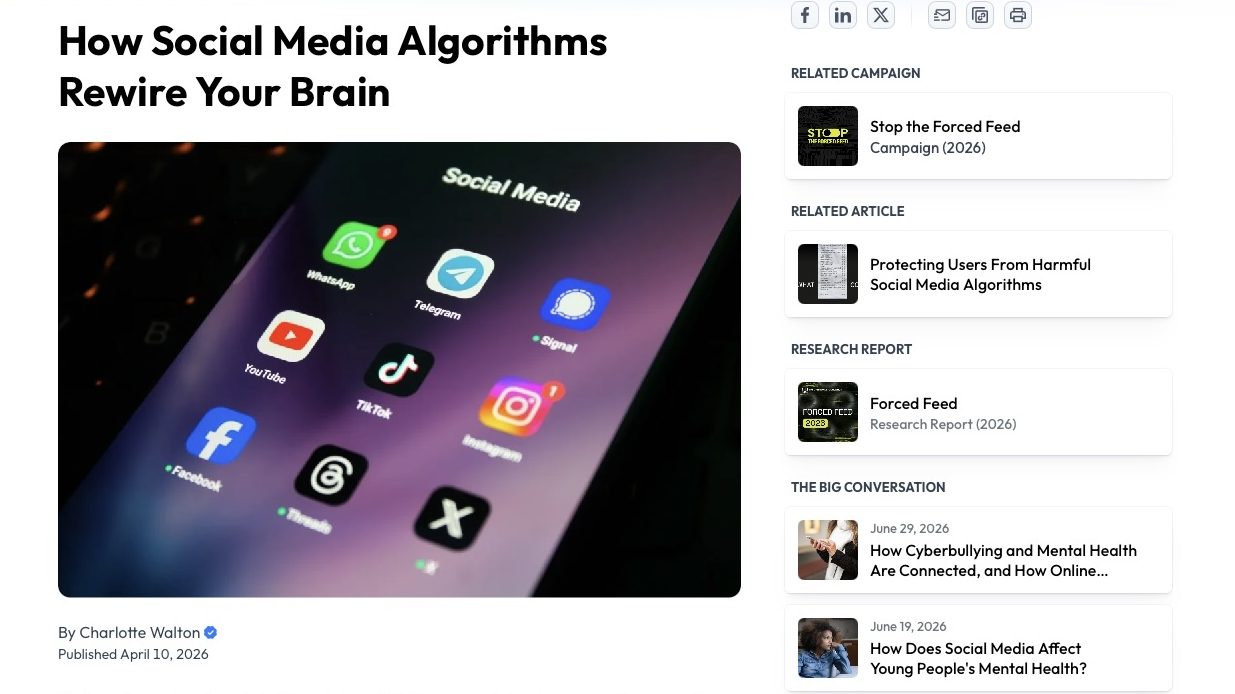
However, I did not want my personal experience to be my only evidence. I found a peer-reviewed article by Marciano et al. (2023) that reviewed research examining relationships between screen use and the developing brain. This helped me understand that researchers have studied connections between digital media use and brain structure and function. It also reminded me that saying social media simply “rewires your brain” can make a complicated topic sound much simpler than it actually is.
Step 2: Investigate the Source
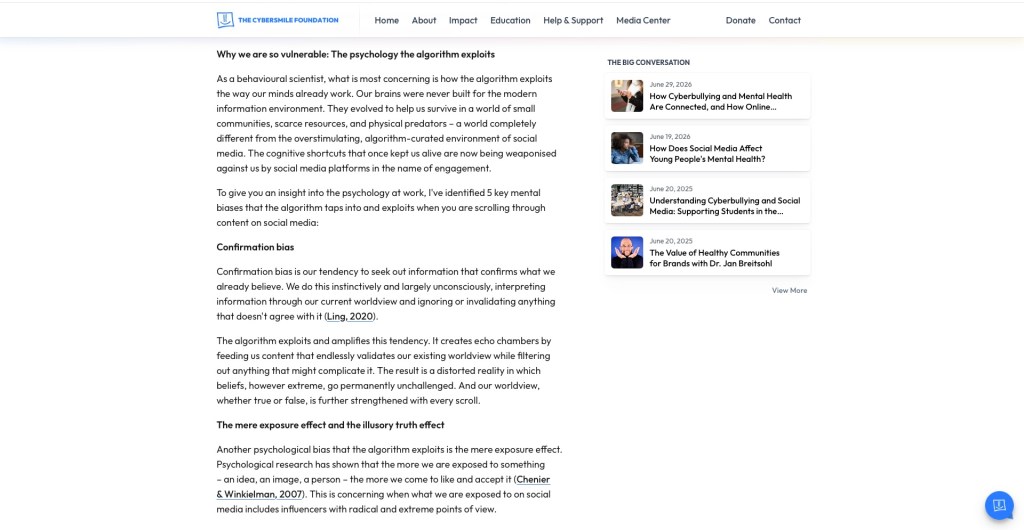
Next, I looked deeper into Cybersmile’s discussion of confirmation bias. Confirmation bias is our tendency to pay more attention to information that supports beliefs we already have. Cybersmile explains that social media algorithms can amplify this by repeatedly providing users with content that matches their existing worldview.
This made sense to me because social media platforms learn from our activity. If I continuously watch, like, comment on, or share a certain type of content, I am providing information about what catches my attention. However, I questioned the word “intentionally.” The algorithm may not specifically be trying to strengthen my beliefs. Instead, it may be predicting what content will keep me interested based on my previous activity.
Step 3: Check the Evidence and Read Laterally
I compared the claims with peer-reviewed research instead of assuming they were accurate. I also realized that I had to consider my own confirmation bias. I initially believed the Cybersmile article because it sounded similar to what I had personally experienced. If I had stopped there, I would have accepted information partly because it already agreed with me. Looking at outside research allowed me to separate my personal experience from the evidence.
Step 4: Psychological Effects, Beliefs, and Identity
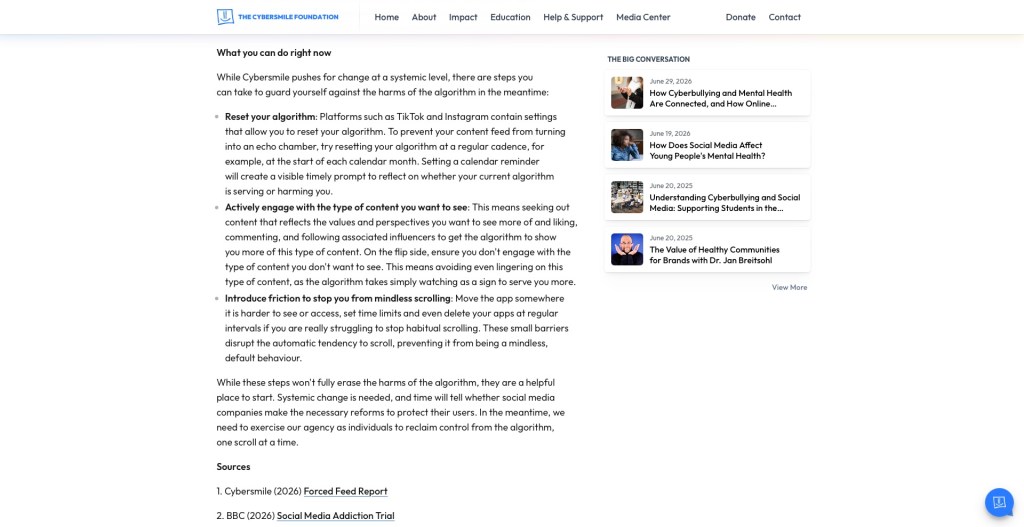
Another concern I found was the potential psychological effect of constantly consuming personalized content. Our feeds can repeatedly expose us to similar opinions, lifestyles, communities, and emotionally charged information. Excessive or problematic social media use has also raised concerns about psychological well-being, although these effects are complicated and do not happen to everyone in the same way.
I also believe repeated exposure can potentially contribute to shifts in beliefs, interests, and how someone understands their identity. If someone constantly consumes the same ideas or viewpoints, those messages may eventually begin to feel more normal or widely accepted. This does not mean an algorithm can simply change someone’s identity, but the information and communities we repeatedly interact with can influence how we think about ourselves and the world around us.
Fearmongering is another concern. Content that creates fear, anger, or outrage can quickly grab people’s attention. If someone continues watching and interacting with that content, the algorithm may recognize their engagement and recommend similar posts. This could create a cycle where someone’s feed makes a situation seem more common, dangerous, or extreme than it actually is.

My Final Assessment
After investigating the claim, I would describe it as partially supported but oversimplified. Social media algorithms can contribute to people repeatedly seeing content that matches their previous interests, behaviors, and viewpoints. However, saying algorithms intentionally show people information specifically to confirm their beliefs makes the process sound more deliberate than it may actually be.
This assignment showed me that misinformation does not always have to be completely false. A statement can contain some truth while still leaving out important context. Using the SIFT method reminded me to stop, investigate the source, find other coverage, and trace information back to evidence before accepting it as fact. Most importantly, our social media feeds are personalized to us. What we constantly see while scrolling does not necessarily represent the full picture of what is happening in the real world.
References
The Cybersmile Foundation. (2026, April 10). How social media algorithms rewire your brain.https://www.cybersmile.org/2026/04/10/how-social-media-algorithms-rewire-your-brain/
Marciano, L., Camerini, A. L., & Morese, R. (2023). The developing brain in the digital era: A scoping review of structural and functional correlates of screen time in adolescence. Frontiers in Psychology, 14, 1108234. https://doi.org/10.3389/fpsyg.2023.1108234
 scrollingforthetruth